
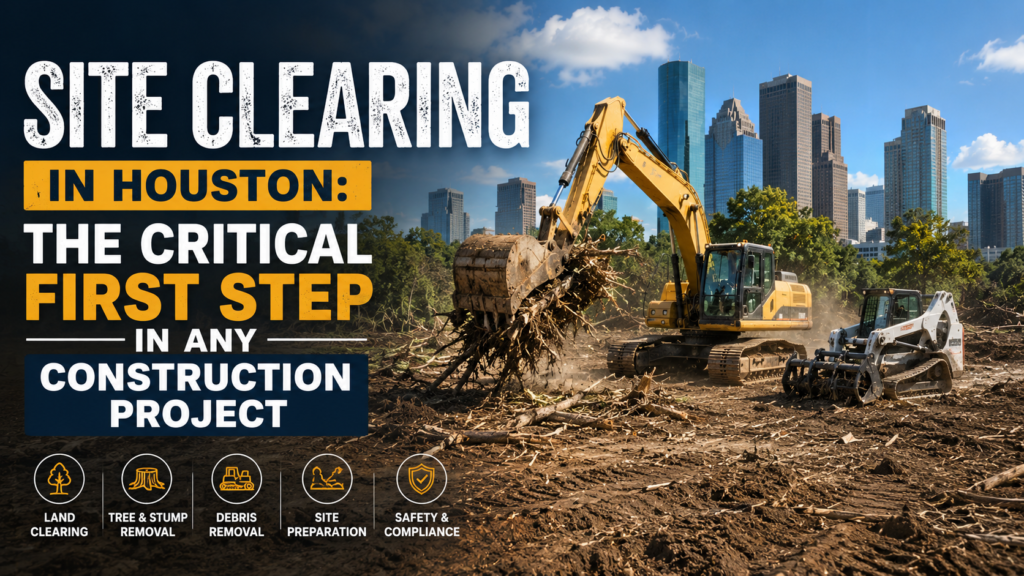
Every structure that rises in Houston every home, office building, retail center, warehouse, or industrial facility begins its life the same way: with a cleared piece of ground. Site clearing is the process that bridges raw, undeveloped, or previously developed land and the clean, prepared surface from which construction can finally begin. It is often the first heavy work that takes place on a job site, and what happens during this phase directly influences the safety, efficiency, and success of everything that follows.
In a metropolitan area as active as Houston, where development pressure pushes constantly outward into previously undeveloped land and also inward as urban infill reshapes older neighborhoods, Site Clearing Houston is a service in steady demand.
Defining Site Clearing
Site clearing is the comprehensive process of removing all vegetation, debris, structures, and surface obstacles from a designated property to prepare it for construction or other development use. It goes beyond simply cutting grass or trimming trees thorough site clearing removes trees, shrubs, root systems, stumps, brush, rocks, and any existing structures or their remnants.
The goal is to produce a clean, accessible, and safe working surface that is ready for the next phases of site development, which typically include grading, excavation, utility installation, and foundation work. A site that has been improperly cleared with hidden stumps, unremoved root systems, or debris pushed below the surface creates problems downstream: equipment damage, delays, and compromised foundations.
What Site Clearing Includes
Tree and vegetation removal is the most visible part of site clearing. Trees ranging from small scrub vegetation to mature hardwoods may need to come down. In Houston, invasive species like Chinese Tallow and Chinese Privet are particularly common and can quickly overtake large areas of land. These trees reproduce aggressively and, if not properly removed along with their root systems, can regrow through cleared ground.
Stump removal follows tree felling. Simply cutting a tree at ground level leaves behind a stump and an extensive root system that occupies underground space, can continue decomposing and creating voids in the soil, and may even regenerate growth. Stump grinding mechanically reduces the stump to chips, typically to a depth of several inches below grade, while full stump extraction pulls the entire root mass from the ground the more thorough option for sites where foundations or paving will be installed.
Brush clearing removes low-growing vegetation, dense undergrowth, and invasive species that may not rise to tree height but still obstruct the site and complicate equipment access.
Demolition of existing structures is often part of site clearing when previously developed land is being redeveloped. Old buildings, foundations, driveways, fences, and retaining walls may all need to go before clearing can be considered complete.
Debris removal hauls away all of the material generated during clearing, leaving the site clean and ready for the next phase of work.
Site Clearing Methods in Houston
Bulldozing is among the most efficient clearing methods for large, heavily vegetated areas. A bulldozer pushes trees and brush over and separates them from the ground. The method is fast and cost-effective for bulk clearing, though it can disturb topsoil significantly and may not fully address root systems, requiring follow-up grubbing.
Forestry mulching has become increasingly popular as an alternative to traditional bulldozing. A specialized machine a forestry mulcher grinds trees, brush, and stumps simultaneously, producing a layer of mulch that stays on site rather than requiring transport and disposal. The mulch layer protects the soil, reduces erosion, and decomposes over time to return organic matter to the ground. For sites where the foundation area will use a concrete slab, stumps and root systems must still be removed from the building footprint rather than mulched in place.
Mechanical clearing using excavators and skid steers is common for selective clearing, where specific trees or structures need to go while others are preserved. This approach offers precision that bulldozing does not, making it well-suited for residential lots where heritage trees, neighboring property lines, and existing structures require careful navigation.
Permitting and Regulations in Houston
Site clearing in Houston and Harris County is subject to a web of local and state regulations that responsible contractors navigate as part of their standard process. Municipal building codes govern tree removal in many Houston-area jurisdictions, with some cities and homeowners associations having specific tree preservation requirements. Harris County Flood Control District regulations address how clearing and subsequent development may affect drainage and stormwater runoff.
Projects near wetlands, floodplains, or environmentally sensitive areas may require permits from the Army Corps of Engineers or the Texas Commission on Environmental Quality. The Texas Pollutant Discharge Elimination System (TPDES) program requires erosion control plans and best management practices for sites that disturb more than one acre. Understanding these regulatory touchpoints is part of what separates experienced site clearing contractors from those unfamiliar with Houston-specific requirements.
Houston’s Specific Clearing Challenges
Houston’s climate and geography create site clearing conditions that differ from many other U.S. markets. The subtropical climate produces rapid, dense vegetation growth that can make a neglected parcel difficult to access. Seasonal humidity and rainfall keep vegetation green and actively growing for much of the year. Even recently cleared parcels, if left unattended, can see significant regrowth in a matter of months.
The region’s flat topography means that drainage patterns on a cleared site become important immediately. Removing vegetation exposes bare soil to rainfall, and without proper erosion control measures, runoff can cause problems both on site and on neighboring properties. Experienced clearing contractors in Houston address this proactively, implementing silt fencing, sediment controls, and other best management practices as part of the clearing operation.
In urban infill contexts where a lot within an established Houston neighborhood is being cleared for redevelopment the proximity of neighboring homes, existing utility lines, mature trees on adjacent properties, and the tight constraints of narrow lots demand careful equipment selection and precise operator skill. The large equipment used on open rural parcels may not be appropriate or even accessible on a constrained urban lot.
The Connection Between Site Clearing and Construction Success
The quality of site clearing work has a direct impact on what happens next. Poorly cleared land with hidden debris, unremoved root systems, or inadequate erosion control creates complications in every subsequent phase of site development. Grading cannot be accurate if buried stumps create voids that collapse later. Foundations cannot be properly prepared if organic material remains in the building footprint. Equipment operators face increased risk if subsurface debris creates unexpected obstructions.
Thorough, professional site clearing done by a crew with appropriate equipment, relevant local experience, and an understanding of what the downstream phases of development require sets the construction project up for success from its very first day of activity on the ground.
In Houston’s relentlessly growing real estate market, that starting point matters more than most people outside the construction industry ever realize.